
5 October 2026
The world's most common pain lives in your lower back. Here is how Dr. Sirichan looks at it.
5 min read
In June 2023 the World Health Organization put it into one plain sentence. Low back pain, it wrote, is "the single leading cause of disability worldwide."
Not heart disease. Not diabetes. The lower back.
The WHO counted 619 million people living with it in 2020 and expects that number to reach 843 million by 2050. The figures come from a large global analysis published the same year in The Lancet Rheumatology. When pain lasts longer than twelve weeks, doctors call it chronic. For a lot of people it has been there for years, and they have stopped counting.
If you grew up in Europe, North America or Australia, you probably know someone like this. Maybe you are that person. The back that "goes" every few months. The physio exercises that help for a while. The massage that feels wonderful on Tuesday and is forgotten by Thursday.
The same WHO fact sheet says something else that rarely makes the headlines: painkillers should not be the first-line treatment. It recommends looking at the whole person, how they move, work, live and carry stress, before deciding what to do. Dr. Sirichan has been working that way for more than 30 years.
The back you brought with you
Moving to Chiang Mai changes a lot. The weather, the food, the pace. The back usually comes along unchanged.
Many of the people who walk into Dr. Sirichan's clinic in San Kamphaeng have lived here for a while, or are staying for a few months between other places. Their stories sound alike. Years of desk work back home. A laptop on a café table now, often on a chair that was never meant for eight hours. Long flights, scooter rides, a new mattress every few weeks. And a body that has learned to brace itself.
Most of them have tried a lot already. Doctors, scans, physio, chiropractors, a massage every week. Some of it helped. Little of it lasted. Somewhere along the way they stopped expecting an answer and started managing the pain instead.
If that sounds familiar, you are in good company. It also doesn't have to stay that way.
Why Dr. Sirichan doesn't start with the massage
Dr. Sirichan was eight when she began working at the elbow of her grandmother Wissim, a midwife and master of Thai herbal medicine. Today she is a Doctor of Thai Traditional Medicine, licensed by the Thai Ministry of Public Health, with more than 30 years in clinical practice. Much of that time she has spent with people whose complaints had been around for a long while.
What she has seen in those years is simple to say. A back that keeps hurting is rarely only a back problem. In Thai traditional medicine, a complaint that returns again and again usually points to something out of balance elsewhere too. The belly may be tight. Sleep may be shallow. The body may have been holding on to tiredness for so long that the muscles never fully let go.
That is why she doesn't begin by working on the spot that hurts. A massage on a back she hasn't read first would be a guess. So she looks first, and decides afterwards what to treat and how often.
What happens in those twenty minutes
The Individual Assessment takes about twenty minutes, and at the moment Dr. Sirichan does every one herself. She reads your body the traditional way, with four tools she has used all her working life.
- Looking. She watches how you stand, move and hold yourself, and looks closely at your skin and eyes.
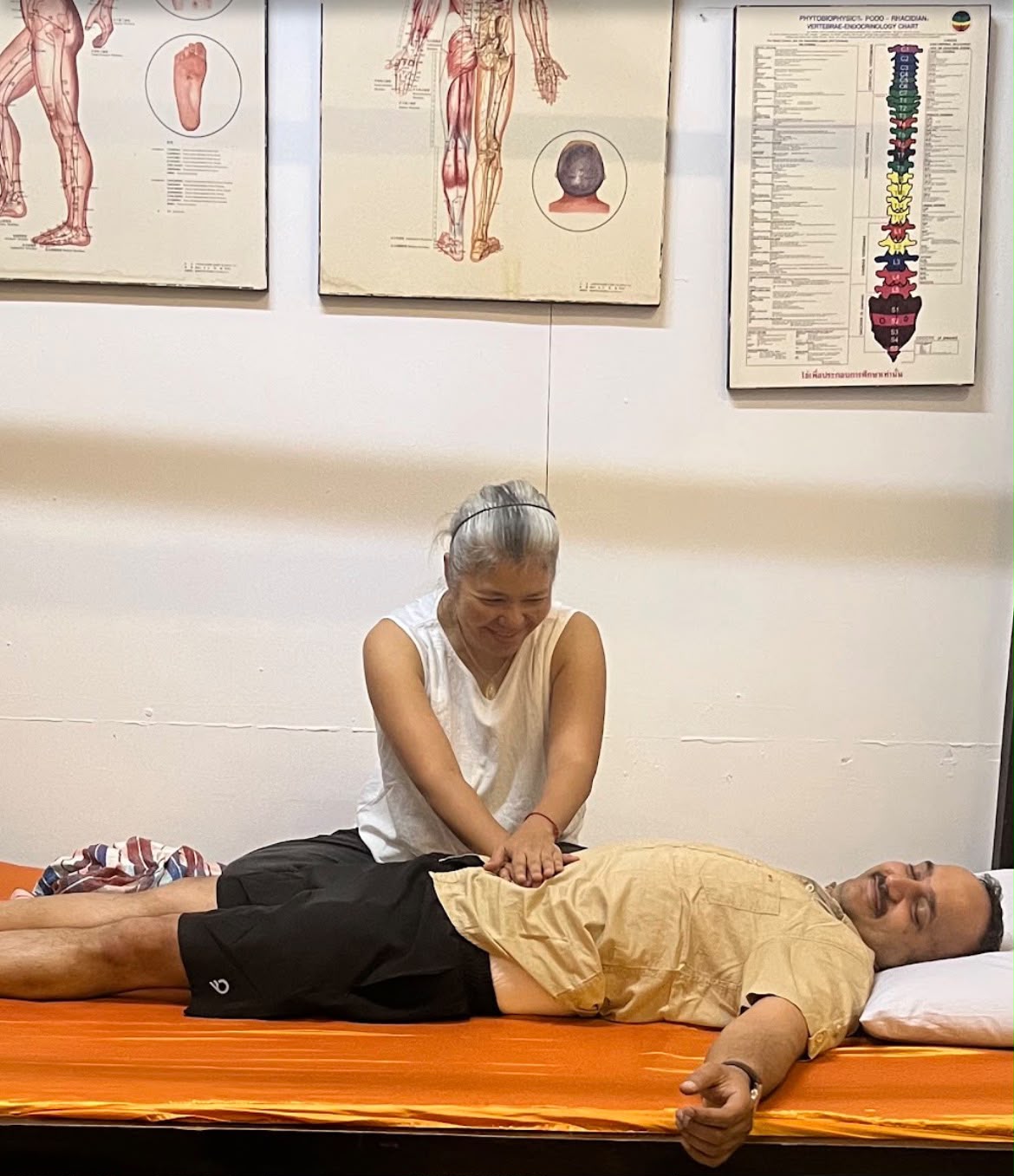
- Touch. With her hands she follows the back, the belly and the limbs and finds where the tension sits.
- Iridology. In Thai traditional medicine the iris is one of the places that shows how the body is coping.
- Pulse reading. For Dr. Sirichan the pulse says far more than a heart rate. It is one of the oldest tools she learned from her grandmother.
At the end she tells you in plain words what she noticed and what she would suggest. For long-standing back pain that is often a short series of treatments or the 3-Day Thai Body Reset. Sometimes it is a few things you can change at home. You decide afterwards, and you don't have to book anything else.
"I came to visit on the account of excessive pain through my shoulders and lower back [...] after visiting many massage specialists with no resolve. After 1 hour I was able to sit straight."
Individual experiences. Results vary from person to person.
If you are already seeing a doctor or a physio, you can still come. Tell Dr. Sirichan what you are doing at the moment, and bring any reports if you like.
Book your assessment
843 million people by 2050 is a big number. Your back is just one of them, and it has its own story. The assessment is where Dr. Sirichan starts to hear it.
Twenty minutes at the Sirichan clinic in San Kamphaeng, Chiang Mai. The assessment on its own is 490 THB, or 1,200 THB if you'd like a 60-minute treatment straight afterwards. Afterwards you know what she sees and what she would do.
Or message us on WhatsApp: +66 83 804 2781